Platform comparison
Multibagg AI alternative for market intelligence
Iris researches stocks and portfolios. FinGenie explains the market. Full 2026 pricing and when to use each.
 FinGenie
 FynSightFinGenie
Honest take: Multibagg Iris wins company research. FinGenie by FynSight wins market intelligence. Use both. Do not force a fake single winner.
Ask FinGenie freeQuick answer
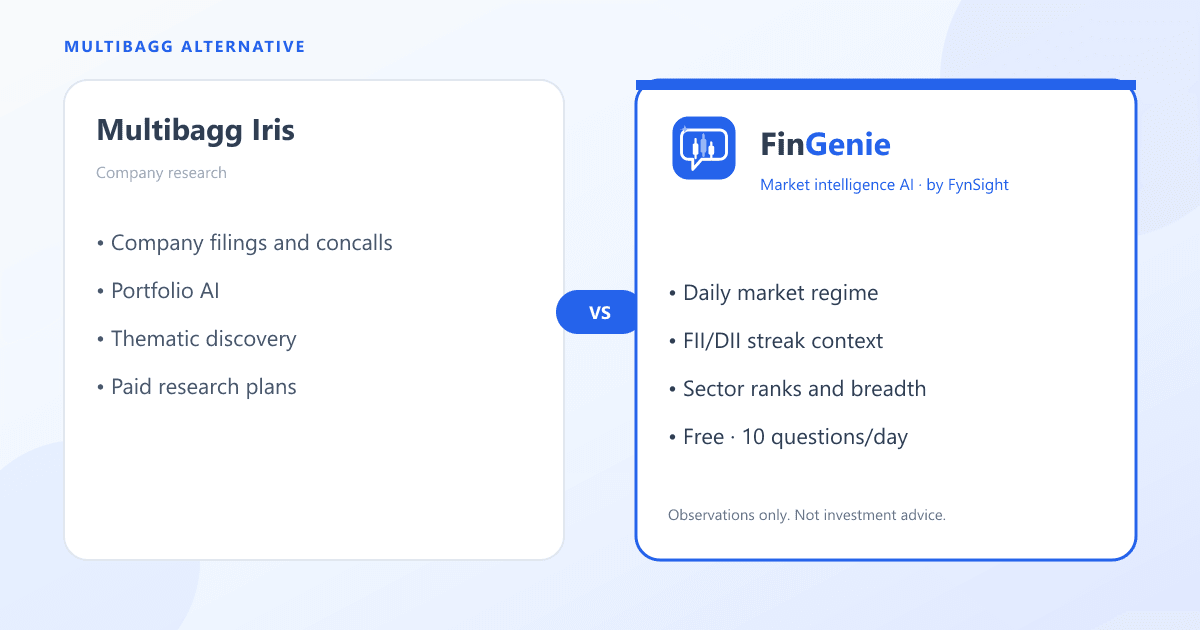
Multibagg AI (Iris) is an AI stock research and portfolio platform for Indian equities. It shines at filings, concalls, discovery, and portfolio questions. FynSight FinGenie is a financial market intelligence AI. It shines at regime classification, FII/DII streaks, sector ranks, breadth, and crypto cycle context. This page is a Multibagg alternative guide for investors who need market context, not a claim that FinGenie replaces Iris for stock research.
Quick verdict: alternative for what?
Search “Multibagg alternative” and you will find people hunting for cheaper Iris clones, better portfolio tools, or another Shark Tank style stock AI. That is the wrong frame for FynSight.
FynSight is a Multibagg alternative only for a specific job: understanding the market before you research the stock. Iris answers “what is inside this company?” FinGenie answers “what kind of market are we in today?” Those questions sit next to each other in a real investor's day. They are not the same product.
If you want a free or cheaper Iris for concall summaries, look at Screener AI or stay on Multibagg's free tier. If you want daily classified regime, FII streak context, and sector leadership in plain English, FinGenie is the tool built for that lane. Many investors will keep Multibagg for stocks and add FinGenie for market character. That is the intended outcome of this page.
What Multibagg AI does well
Multibagg AI, built by Finsky Technologies, positions itself as an AI-native equity research platform for NSE and BSE listed companies. The chatbot Iris is the center of gravity. Iris is marketed as a stock market analyst with access to annual reports, investor presentations, conference call transcripts, exchange filings, and structured financial tables. The internet is a fallback, not the primary source. That design choice matters. Generic ChatGPT answers often miss the exact filing you needed. Iris is built to start from official documents.
Beyond chat, Multibagg ships a broader suite. Portfolio connections sync broker holdings for allocation and risk style questions. Discovery buckets surface thematic ideas such as AI, EV, or semiconductors. Watchlists, alerts, screeners, IPO tools, ETF views, bulk and block deal explorers, earnings trackers, and sector deep dives sit around Iris. Market Pulse includes FII/DII activity pages. That is useful headline flow data. It is not the same as FynSight's streak classification and absorption context, but it shows Multibagg is not only a chatbot.
Shark Tank visibility and claimed traction (tens of thousands of investors, large Iris question counts) give Multibagg distribution Multibagg earned in public. For a retail investor who wants one place to ask “summarize Eternal's latest concall” or “list red flags in my portfolio,” Iris is a serious product. Respect that. An honest Multibagg alternative page does not pretend FinGenie does those jobs better.
Multibagg also aims at institutions with an Enterprise tier: shared research, seats, roles, concall monitors, and founder-led onboarding. That is a different buyer than FinGenie's current free retail market intelligence user. Do not confuse enterprise document AI with a public Market GPS.
Multibagg pricing in 2026 (what you actually pay)
Pricing changes with promos. The figures below reflect Multibagg's public pricing page during the Shark Tank yearly discount window. Always verify on multibagg.ai/pricing.
| Plan | Price signal | Iris questions | Best for |
|---|---|---|---|
| Standard | Free | About 20 / month | Trying Iris and basic tools |
| Premium | About ₹7,199 / year on promo | About 500 / month | Active stock researchers |
| Professional | About ₹8,999 / year on promo | About 1,000 / month | Power users, deeper history |
| Enterprise | Custom | Unlimited | Teams and institutions |
Premium and Professional yearly list prices sit higher (near ₹11,999 and ₹14,999) before the 40% save messaging. Paid plans unlock more financial document history (roughly 20 to 40 quarters), more watchlist capacity, portfolio connections, advanced models, alerts, and on higher tiers data export plus India and US market access as marked upcoming or included depending on plan copy.
Compare that with FinGenie: free sign-in, 10 questions per dayfor market intelligence. You are not buying 40 quarters of filings. You are asking about today's regime and flows. If your budget is ₹0 and your question is market character, FinGenie is the cheaper fit. If your budget is ₹7,000 to ₹9,000 a year and your question is company research, Multibagg Premium or Professional is the product you are shopping for.
What FynSight and FinGenie do well
FynSight is a financial market intelligenceplatform. The daily pipeline after market close classifies India's market regime, tracks FII and DII flows with streak context, ranks eight Nifty sectors, measures breadth, builds causal stories, and matches today to historical setups. Public pages such as Market GPS, the daily brief, sector hubs, and programmatic today pages publish that intelligence. FinGenie is the question layer on top.
Ask FinGenie what regime India is in. Ask whether FIIs are still selling. Ask which sector leads. Ask whether the Nifty move is broad or narrow. Ask where Bitcoin sits in its cycle. Answers are grounded in published FynSight data with sources where applicable. Observations only. Not investment advice. Not a SEBI-registered advisor. No buy or sell language.
That is a different category from Iris. Multibagg can show FII/DII activity in Market Pulse. FynSight treats institutional flows as an intelligence problem: streak length, intensity, DII absorption, and how those flows sit inside a named regime. Multibagg can list sectors and industries. FynSight scores sector leadership daily and ties it to regime playbooks from historical observation. Multibagg can help you research a bank stock. FinGenie can tell you whether banking is leading the market today and whether breadth supports the index.
Financial market intelligence guide →Side-by-side comparison
| Capability | Multibagg Iris | FynSight FinGenie |
|---|---|---|
| Company filing Q&A | Core strength | Not primary focus |
| Concall and AR chat | Strong | Not built for this |
| Portfolio AI | Strong | No |
| Thematic stock discovery | Strong | No |
| Stock screener depth | Good | No |
| Daily market regime (7 types) | Not core | Core product |
| FII/DII streak intelligence | Activity pages | Streaks + context |
| Sector ranks scored daily | Sector tools | 8 Nifty sectors scored |
| Market breadth / narrow leadership | Limited | Core |
| Historical similar setups | No | Yes |
| Crypto cycle context | No | Yes (CCF) |
| Free AI volume | About 20 Iris / month | 10 FinGenie / day |
| Paid research depth | ₹7k–9k / year typical | Market layer free |
| Best for | Stock and portfolio research | Market character Q&A |
Jobs each tool owns
Product strategy is clearer when you map jobs, not features. Iris owns the job of compressing hours of company document reading into minutes. That job includes IPO RHP scans, concall digests, peer notes from filings, and portfolio questions tied to your holdings. Multibagg's pricing and prompt limits make sense once you see token-heavy document work as the cost center.
FinGenie owns the job of answering market character questions after 3:30 PM IST and into the evening when FynSight publishes. That job includes regime labels with confidence, flow streaks, sector leadership, breadth quality, and crypto cycle readings. The cost center is a validated daily pipeline, not per-document token burns for every retail question. That is why a free daily quota is viable for market Q&A while filing AI often meters usage.
When investors confuse these jobs, they ask Iris for regime classification it was not designed to publish, or they ask FinGenie for a 40-quarter filing deep dive it was not designed to run. Both products look worse than they are. Use each for the job it owns.
When to use which
Use Multibagg Iris when you need a concall summary, filing red flags, thematic stock lists, IPO document help, portfolio diversification questions, or broker-synced holding analysis. Pay for Premium or Professional when 20 free monthly prompts are not enough and document history matters.
Use FinGenie whenyou need today's regime, FII/DII streak meaning, strongest or weakest sector, breadth confirmation of a Nifty move, similar historical setups, or Bitcoin cycle context. Stay on the free tier for daily market habit. Open the FinGenie Hub for examples.
Use both whenyou research a stock inside a market. Example workflow: ask FinGenie whether the market is Narrow Leadership with FII selling. If yes, treat index strength with caution. Then open Iris to research a specific company's filings inside that context. Market first, stock second.
The India investor AI stack
Multibagg is one layer. Screener.in is another. FinGenie is the market layer. A practical 2026 stack looks like this: Screener for ratios and screens, Multibagg Iris for filings and portfolio, FinGenie for regime and flows, Moneycontrol for breaking news. No single app owns the whole day.
Limits and honesty
FinGenie will not replace Multibagg for document chat, portfolio sync, or thematic discovery. FynSight does not claim Shark Tank distribution or Multibagg's company document corpus. If someone sells you FinGenie as a drop-in Iris replacement, they are overselling.
Multibagg will not replace FinGenie for daily classified regime, scored sector ranks, breadth intelligence, or crypto cycle pillars. If someone sells you Iris as a complete market intelligence layer, they are also overselling. Paid Multibagg features marked upcoming on the pricing table may change. Treat starred items as roadmap, not guaranteed today.
Both platforms can make mistakes. Multibagg says AI can make mistakes and prices may be delayed. FynSight publishes only after validation gates and still frames output as observation. Your judgment stays in the loop.
A week in the life: Multibagg user vs FinGenie user
Picture two investors with the same broker and the same watchlist. Investor A lives inside Multibagg. Monday they ask Iris to summarize a concall. Tuesday they explore an EV discovery bucket. Wednesday they sync the portfolio and ask about concentration. Thursday they scan IPO notes. Friday they set alerts. That is a strong company research week. What they may never ask is whether the market regime turned Narrow Leadership midweek while FIIs extended a selling streak. Their stock work can be excellent and still sit inside a fragile tape.
Investor B opens FinGenie after the close each day. They ask regime, flows, and sector leadership. On Tuesday FinGenie flags weak breadth. Investor B still uses Multibagg on Wednesday, but they size ideas differently and they read concalls with a market filter. The stack is not more screens. It is better sequencing.
Investor C tries to force FinGenie to replace Iris. They ask for forty-quarter filing digests and get a redirect toward company research tools. They leave disappointed and write a one-star review that FinGenie is not Iris. That review is true and irrelevant. FinGenie was never sold as Iris. This page exists so Investor C does not buy the wrong expectation.
The best outcome is Investor D: Multibagg for stocks, FinGenie for market, Screener for screens, news for headlines. They pay Multibagg when Iris volume justifies it. They keep FinGenie free. They do not argue about which logo is supreme. They argue about which question they are answering at 7 PM IST.
SEO and category: why Multibagg alternative pages matter
People search Multibagg alternative for three reasons. Price resistance after seeing ₹7,000 to ₹9,000 yearly plans. Feature gaps such as wanting more free Iris prompts. Category confusion after Shark Tank, when every AI finance product looks interchangeable. FynSight can win the third reason with clarity and the first reason only for market Q&A, not for filing depth.
If your landing page claims to be a full Multibagg killer, you invite churn from users who needed concalls. If your landing page claims to be the market layer Multibagg does not publish as a daily classified product, you invite the right users. That is how comparison content becomes durable SEO instead of bait.
Internal links reinforce the mesh: Finance AI, best AI for finance, India AI stack blog, and the FinGenie ask library. External readers should leave understanding the job split even if they stay on Multibagg for research.
Data philosophy: filings corpus vs market engines
Multibagg's Iris philosophy is document-first. Official filings and tables beat random web snippets. That is the correct philosophy for company diligence. FynSight's philosophy is engine-first. Validate market inputs, classify regime, score sectors, measure breadth, then let FinGenie speak in plain language. That is the correct philosophy for market character.
Mixing philosophies creates mush. A model that half-reads filings and half-guesses regime without a published classification will sound fluent and still mislead. Prefer tools that are opinionated about their source of truth. Iris: filings. FinGenie: published FynSight intelligence. Screener AI: Screener's document store. ChatGPT: general reasoning. Each source of truth implies a different trust boundary.
FynSight also refuses investment-advice language by design. Multibagg warns that AI can make mistakes. Those disclaimers are not decoration. Retail India is full of tip culture. A Multibagg alternative that quietly becomes a tipster channel is a compliance and trust failure. FinGenie stays observational: what kind of market, where money moved, what to watch. You decide actions.
Migration guide if you already pay Multibagg
Do not cancel Multibagg because you read this page. Keep Iris if you use it weekly for filings or portfolio. Add FinGenie as a five-minute closing ritual. For one week, write two lines in a note: regime and FII streak from FinGenie, then the Iris question you asked. You will see whether your research was market-aware.
If you are on free Multibagg and hit the twenty Iris prompt wall, decide whether the next rupee should buy Multibagg Premium or whether you actually needed market context you can get free from FinGenie. Many people upgrade Iris when their real frustration was index confusion. Spend against the frustration, not against the loudest ad.
If you outgrow FinGenie's ten daily questions, that is a product signal for a future paid quota. It is not a reason to pretend FinGenie suddenly includes Multibagg's document vault. Buy depth where depth lives.
Try FinGenie free for market questions
Sign in free. Ask a market question. Ten per day. If you still need Iris for the stock, keep Multibagg. The Multibagg alternative that matters is not a clone. It is the missing market layer.
FinGenieFinGenie by FynSight
Ask the market, not just the stock
Free FinGenie: regime, FII/DII, sectors, and breadth from published FynSight data. Ten questions per day.
FynSightMarket observations only. Not investment advice.
Frequently asked questions
Is FynSight a Multibagg AI alternative?
For market-level intelligence (regime, FII/DII flows, sector ranks, breadth), yes. For company filing research, concall summaries, and portfolio AI, Multibagg Iris is stronger. Most serious investors benefit from both. They are complements, not clones.
What is the difference between Iris and FinGenie?
Iris answers company-level questions from NSE/BSE filings, concalls, and portfolio data. FinGenie answers market-level questions from FynSight's daily intelligence pipeline: regime classification, institutional flow streaks, sector ranks, breadth, and crypto cycle context.
How much does Multibagg AI cost in 2026?
Multibagg offers a free Standard plan with about 20 Iris questions per month. Premium is around ₹7,199 per year on the yearly promo (list near ₹11,999). Professional is around ₹8,999 per year on promo (list near ₹14,999). Enterprise is custom. Always check multibagg.ai/pricing for current offers.
Is FinGenie free compared to Multibagg?
FinGenie offers free sign-in with Google, email, or OTP and 10 questions per day for market intelligence. That is roughly 300 questions per month for regime, flows, and sectors. Multibagg's free tier is tighter on Iris prompts. Paid Multibagg unlocks deep stock research FinGenie does not try to replace.
Does FinGenie analyze individual stocks like Multibagg?
FinGenie is optimized for market context, not deep single-stock filing analysis. For concall summaries, balance sheet questions, and portfolio red flags, Multibagg Iris or Screener AI is more appropriate. FinGenie can still discuss sector context around a stock's industry.
Can I use Multibagg and FinGenie together?
Yes. A practical stack is FinGenie for daily market character, Multibagg Iris for company and portfolio research, and Screener.in for ratio screens. Start with the market, then pick stocks inside that context.
Does FinGenie give buy or sell advice?
No. FinGenie and FynSight provide market observations only. FynSight is not a SEBI-registered investment advisor. No buy, sell, or hold language.
Who should choose FinGenie over Multibagg?
Choose FinGenie when your question is about the market: regime, FII selling streaks, DII absorption, sector leadership, breadth quality, or Bitcoin cycle context. Choose Multibagg when your question is about a company, IPO filing, or your portfolio holdings.
FinGenieMarket Intelligence Analyst
Understand today's market before tomorrow's decisions
FinGenie never answers a market question without first understanding today's market state.
Intelligence hub cluster
FynSight provides market observations only. Not a SEBI-registered investment advisor.